June 24, 2025 · 6 min read
Search Everywhere Optimisation: Implement SEO 2.0 before it’s too late.
Are you losing organic traffic from Google? This is one of the most common concerns many businesses are experiencing now. In this article, we'll tell you why this is happening and what to do if you want your brand to remain visible for your audience. In short, times are changing: AI is reshaping marketing in general, disrupting search engines and, therefore, SEO strategies.
What is Search Everywhere Optimisation, and why does it matter for your brand?
The first thing to remember is that SEO (Search Engine Optimisation) does not mean Google. SEO is about providing a solution to the needs that users have when they perform an online search. With that in mind, let's move on to defining what the new SEO 2.0 means.
Search Everywhere Optimisation, aka SEO 2.0, represents a new strategy in terms of online visibility. It extends beyond traditional search engines, such as Google, ensuring that businesses can be discovered wherever potential customers conduct their searches.
The scope of SEO 2.0 encompasses numerous digital touch points, including social media, voice search technologies, and generative AI platforms (LLMs) like ChatGPT.
Key Concepts in Search Everywhere
Customer journey mapping: Understanding the customer journey is crucial. We must identify where our potential customers conduct their searches: Social media? Google? Perplexity? Logically, if we are not where our customers are, our brand will be invisible to them.
Optimised content beyond traditional search engines: It is essential to tailor content and strategies to different channels. Optimising content for Google, TikTok, or Instagram is not the same thing; each platform demands a unique approach.
Content versatility: Building on the previous point, brands must focus on creating diverse content formats to capture attention across various platforms. This includes not just written articles but also videos, podcasts and engagement tools to name a few.
Data-driven insights: By analysing the behaviours and preferences of target audiences, brands can refine their strategies. Remember: Never stop optimising and trying new things.
CTA: Book a free consultation to optimise your strategy.
But… Why is this happening right now?
You may think that AI is the unique reason, but although it is the main one, it is not the only one. Here are the three main aspects to consider:
The implementation of Google AIO in the Google search engine.
Since Google incorporated this new 'skill' into its search engine, it has become less and less necessary to visit external sites. Google provides direct answers, especially to informational queries, and users can find almost everything they need in the search engine itself. For example, a recent study by Ahrefs (based on the US market) indicates that the CTR (Click-Through Rate) has decreased by 34.5%.
However, Google ensures that when a website is cited in AI Overviews responses as a source, it receives visits from users who are more likely to convert. We actually have little information about this, as Google does not share metrics on this topic.
Standard result: #1 position:
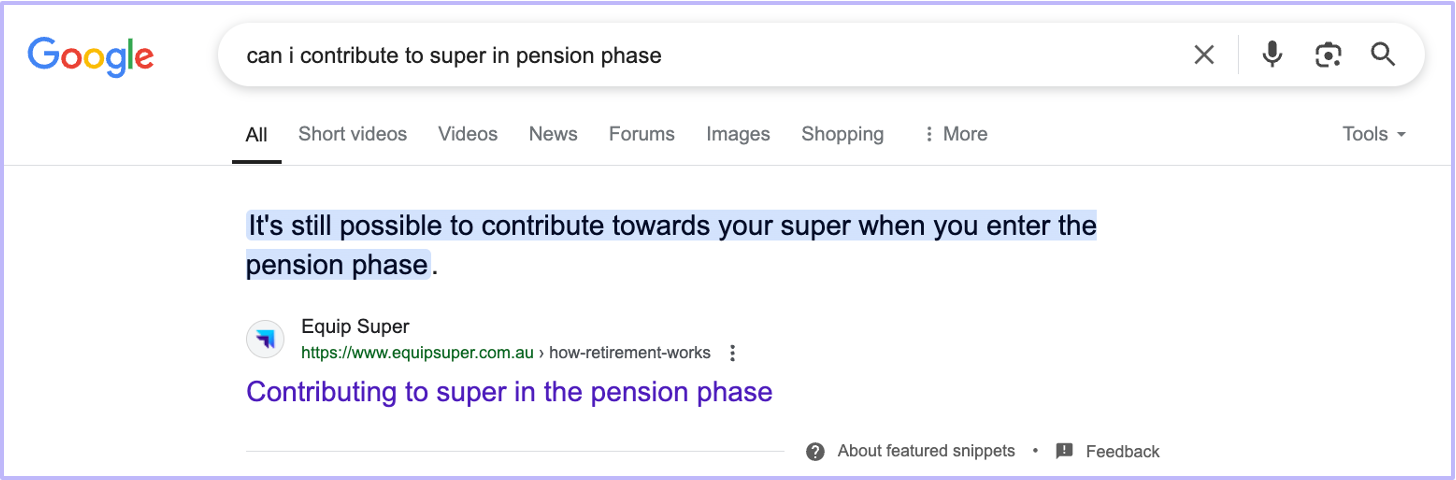
An example of an organic search result in 1st position, without an AI Overview.
Google AI Overview result: #1 position:
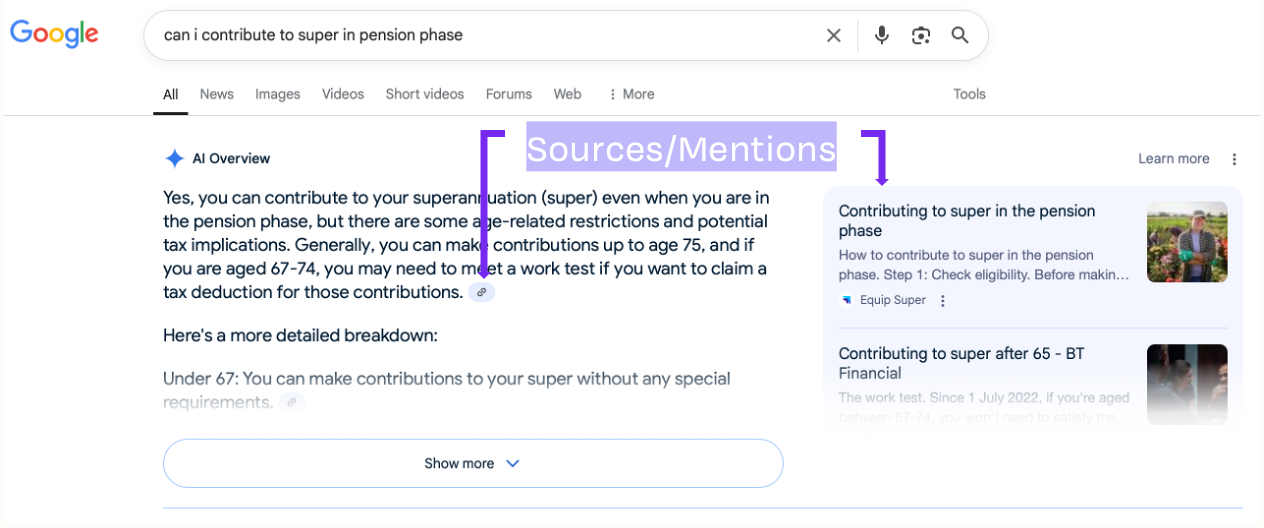
An example of an organic search result in 1st position within an AI Overview.
During Google IO 2025, Google unveiled its new AI Mode tool (released in the U.S.), which appears to be a hermetic AI-based version. In other words, the 10 blue links that have been with us for decades will gradually become less visible and less relevant.
Changing patterns in user behaviour
As technology advances, user search behaviours are rapidly transforming. The rise of new platforms and tools is reshaping how we search, find and consume information online.
Users today prefer visual and multimedia content, often leading them to platforms like YouTube, Tik Tok or Instagram. Do users use these platforms just for entertainment? No, they are also using them for product discovery and brand interaction.
Studies such as the one presented by Search Engine Journal indicate that Gen Z uses social media as previous generations used Google.
Rise of generative AI platforms (LLM)
At the time of writing, ChatGPT is used by more than 800 million users per week (more information in this article by Forbes). So what does this have to do with SEO? Well, as you may know, this tool not only provides personalised answers to any question you ask it, but it also has its own search engine.
Therefore, the consequences of all this are as follows:
Google remains the cornerstone of any SEO strategy, but it should not be the only one. You should not put all your eggs in one basket.
SEO 2.0 strategies require greater complexity and specialisation, as well as a broader vision.
Objectives and KPIs will need to be redefined.
So, we return to the question: Is SEO dead? Not at all; we'll tell you why below.
SEO 2.0: Adapting now is a clear competitive advantage.
Big changes always brings big opportunities! Both small and large enterprises can achieve great benefits through effective SEO 2.0 practices:
Increased brand awareness: Consistent visibility across diverse channels amplifies brand recognition among potential customers. In other words, increased presence can drive traffic to primary websites and physical stores.
Enhanced customer engagement: Multi-channel strategies foster deeper connections with audiences through direct interactions and empathy. It is no coincidence that, in many cases, leads coming from platforms such as YouTube are more qualified to convert than those coming through Google. Why? Because users feel closer to a brand when they see a specialist talking in a video than when they read a 1,500-word article on a website.
Competitive edge: Last but not least, stronger brand positioning compared to competitors who are still relying on old SEO strategies.
At this point, you may be wondering what the difference is between SEO 2.0 and content marketing. It's straightforward: although both focus on providing quality content, SEO content is optimised to be found everytime a user performs a search/query on a search engine. SEO content must always meet the needs of users.
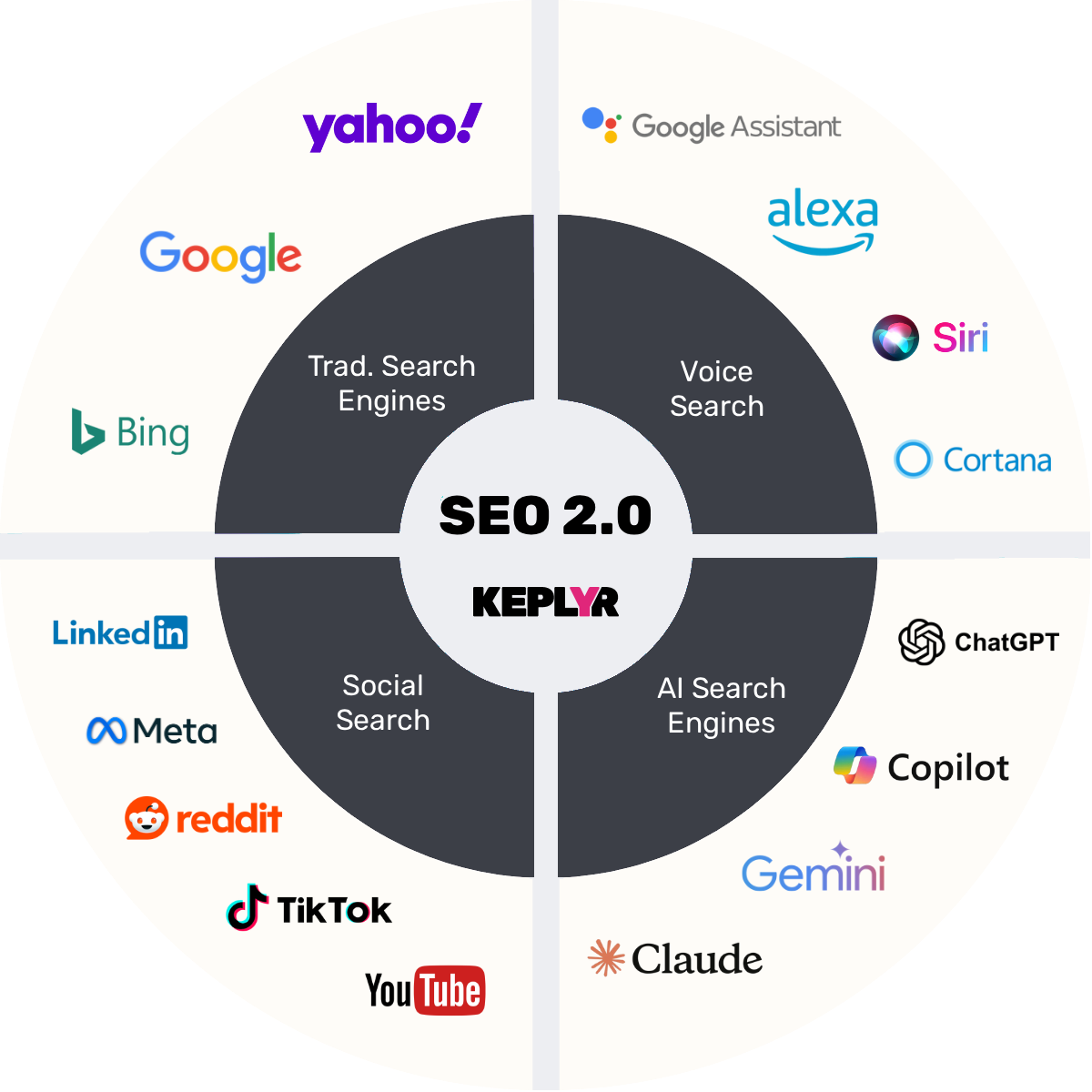
This infographic shows how an SEO 2.0 strategy could include multiple platforms across multiple search channels.
How to implement Search Everywhere Optimisation in businesses
It’s important to remember that Search Everywhere Optimisation (SEO 2.0) is not just about being everywhere, it’s about showing up with relevance, intention, and consistency across all discovery channels.
New strategies must respect the foundations of traditional SEO: high-quality content, authority, expertise, and covering search intent. Always keep this in mind when implementing your new SEO strategy.
Step 1: Identify where and how your potential customers search
Begin with customer journey mapping to understand where your target audience performs searches (Google, YouTube, TikTok, Amazon, forums, voice assistants, etc.).
Step 2: Conduct a multi-channel discoverability audit
Assess your brand's current visibility across all relevant platforms. Identify gaps, strengths, and underperforming areas in your discoverability landscape. In short, evaluate your brand’s authority across all your key digital platforms.
Step 3: Set realistic goals and KPIs
Step 4: Keyword and competitor research (prioritising Google first)
Perform traditional SEO research as a starting point. Identify high-value terms, understand competitors, and find cross-platform keyword similarities.
Step 5: Define roles and coordinate departments
SEO 2.0 requires cross-functional collaboration. Clarify ownership and workflows to align efforts and prevent silos.
Step 6: Create your SEO 2.0 content strategy
It’s time to develop tailored content for each platform!
First, match keyword intent (awareness, consideration and conversion) to the most effective content type and platform, and evaluate resources vs benefits. Some examples:
Important: Use modular content that can be repurposed across channels with native optimisation.
When developing content, write in a conversational manner to try to appear in LLMs and voice search:
Write FAQs, how-tos, and explainer content in natural, question-based language.
Use structured data for FAQs, HowTo, Products.
Ensure answers are concise but informative.
Keplyr can help you implement SEO 2.0
Search Everywhere Optimisation is not a trend. Businesses that embrace this shift early will gain a competitive advantage. The Keplyr team can help you with the entire process.
Contact us to learn more
Related insights

GEO for super funds
A 25-year-old starting their first full-time job used to open Google and type "best super fund". A growing number now open ChatGPT instead and ask it something far more specific: "I'm 25, starting my first job in Australia, what's the best super fund for me?". The AI doesn't return ten blue links.…

The influence of Gen Z is growing
Are super funds ready? Born in the late 90s and early 2000s, the Post-Millennium Generation is the youngest. As digital natives, they are adaptable. They spend more time on social media and their phones than watching television. In addition to leading trends, they also break social norms and set an…

AI and data security: Managing and protecting against risk
AI can enable powerful new user experiences, but what are the data security and privacy risks of using public Large Language Models like ChatGPT? Since the public launch of ChatGPT in late 2022, use of generative AI and Large Language Models (LLMs) has exploded. As organisations look to incorporate…