November 19, 2026 · 12 min read
From 2028, APRA plans to publish your retirement measures. Here’s what to measure before then.
From late 2027, APRA starts collecting retirement data from every fund. From 2028, it plans to publish the results, fund by fund. The measures cover advice take-up, drawdown rates and retirement product use. None of them counts calculator visits or tool completions.
Most funds still measure their retirement communications by opens and clicks. That won’t help when the published numbers arrive.
In brief:
APRA expects data collection to start in late 2027 and the first Retirement Reporting Framework indicators to be published in 2028. APRA will work with the industry on how they’re published.
The published measures include the share of members aged 60 and over who received personal advice, the share drawing at the minimum rate, and take-up of retirement income products. None of them counts whether a member used a calculator or finished a projection.
APRA has told funds it expects a measure for every dollar spent on retirement engagement, and has criticised funds that rely on their suppliers’ own reports instead of the fund’s own measures.
ASIC found that most funds judge the success of their retirement messages by opens and clicks, and that fund-wide retention or advice uptake measured after a campaign is one of the less effective approaches.
Treasury’s best practice Principle 18 asks funds to assess whether their guidance services and engagement strategies actually work, and to collect data on member experiences.
A calculator only shows up in APRA’s numbers through what it leads to. If a member runs a projection, sees they’re short, books a retirement health check and gets advice, the advice shows up. The calculator doesn’t, unless the fund tracks the chain itself.
What APRA will publish, and when
The Retirement Reporting Framework is the Government’s. APRA is building the data collection behind it.
Under APRA’s draft reporting standards, each fund will report on three areas: how many members aged 60 and over received personal advice paid for through their super, how members are drawing down their balances (including the share drawing only the legislated minimum), and take-up of retirement income products including lifetime income products.
APRA will also collect data on members aged 60 and over who close their accounts entirely. The final consultation closed on 9 October 2026. APRA said it didn’t expect further material changes at that stage, and that it would consider all feedback.
The timeline: data collection begins in late 2027. The first indicators are published in 2028. APRA has said it will engage with the industry on publication design through 2027 “to ensure it is meaningful, contextual and accessible”.
Instructions on Personal Advice Access from APRA's Draft Reporting Standard
Field name | Valid values | Description |
2.1 Personal Advice Access | Yes / No | Report if members have access to personal advice via in-house advisors or through a referral arrangement to a third-party provider. Solely providing information on the RSE's website will not be sufficient for a 'Yes' response. |
2.2 Advice Product Availability | Yes / No | Report if any retirement income stream product requires personal advice to acquire an interest. |
Instructions on Personal Advice Take-up from APRA's Draft Reporting Standard
Field name | Valid values | Description |
3.1 Collectively Charged Personal Advice Member Count | Whole numbers | Report the number of members aged 60 or above at the end of the reporting period that received personal advice that was collectively charged, during the reporting period. A "member" represents a natural person who has at least one member account. |
3.2 Charged To Member's Interest Personal Advice Member Count | Whole numbers | Report the number of members aged 60 or above at the end of the reporting period for whom a fee for personal advice was charged to member's interest, during the reporting period. A "member" represents a natural person who has at least one member account. |
Source for tables: APRA, revised draft SRF 607.0 instructions, September 2026, page 25.
Two things APRA has said about how funds should be measuring already:
A measure for every spend. APRA expects funds to show what their spending on retirement engagement achieved against specific outcomes.
Your own numbers, not your supplier’s. APRA has criticised what it calls “undue reliance” on suppliers’ own reporting. If your calculator provider sends you a monthly report and that’s what you take to the board, that’s the gap APRA is pointing at. The fund’s own analytics should capture what happened, independently of what the vendor tells you happened.
Opens and clicks won’t help you
ASIC looked at how funds measure the success of their retirement communications. Most judge it by opens and clicks. Some go further and look at fund-wide retention rates or advice uptake in the period after a campaign.
ASIC’s view is that the second approach, measuring fund-wide outcomes after a campaign, is one of the less effective methods. The problem is attribution: if retention went up in the quarter you ran a campaign, you can’t tell whether the campaign caused it or whether a dozen other things moved at the same time.
Treasury’s best practice principles, published in February 2026, make the same point from the other direction. Principle 18 asks funds to “assess the effectiveness of guidance services and engagement strategies in supporting members to navigate their retirement income solution choice and collect relevant data on member experiences.” That means whether the member actually navigated their options, made a choice and acted on it.
Principle 17 is even more direct. It asks funds to “consider relevant data on measurable outcomes, usage, and member behaviour to improve the quality of its retirement income solution offerings.” The principle asks for usage and behaviour rather than impressions and traffic.
The principles are voluntary and no enforcement action will follow. But the Retirement Reporting Framework isn’t voluntary, and the principles describe what “good” looks like in preparation for it.
What your calculator should count
None of APRA’s published measures counts whether a member used a calculator. A calculator shows up in those numbers only through what happens after the result: whether the member got advice, changed their drawdown rate, or took up a retirement income product.
That means the fund needs to count the chain itself. Here’s a simple ladder, measured among the members who used the tool:
Reached the tool. How many members landed on the calculator page. Most funds already have this number.
Finished it. How many entered their details and got a result. Most funds’ measurement stops here.
Saw where they stand. How many saw a result that told them in plain words whether they’re on track, close or short. Not every calculator does this: we tested 29 and 17 of them did.
Asked for help. How many clicked through to a next step: a retirement health check, a guidance page, an advice booking. This is where attribution starts.
Booked. How many made an appointment with the fund’s guidance team or advice service. This is the number that starts to connect to APRA’s advice metric.
Acted. How many changed something: lifted contributions, switched investment option, started a pension, booked advice. This is the number APRA will publish, and it’s the one most funds can’t trace back to the tool that started it.
Most retirement calculators answer one question: how much will I have? That gets you to rung 2. To get to rungs 3 and 4, the member also needs to know how much they’ll need. Treasury’s Principle 12 names budgeting tools and expenditure calculators alongside projections for exactly this reason. Our Retirement Lifestyle Calculator walks the member through their own retirement budget, category by category, and produces a personalised income target. Every input and the income figure they land on fires as a structured event to the fund’s own analytics, not only ours. That’s what turns a projection into a gap analysis and gives the member a reason to ask for help.
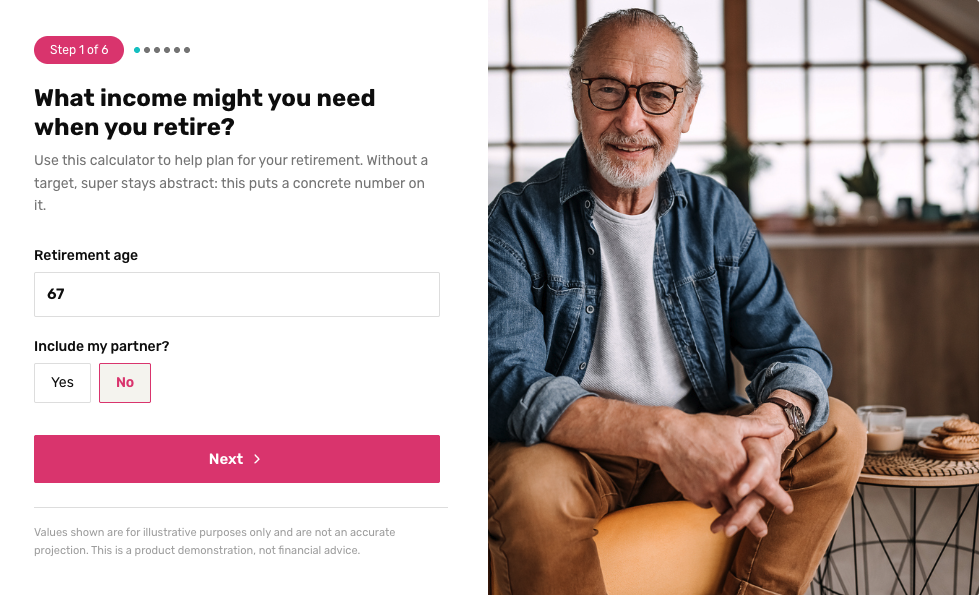
Every rung on the ladder should land in the fund’s own analytics, not only the calculator provider’s. If the fund can count rungs 1 and 2 from the provider’s report but can’t see rungs 3 to 6 in its own data, the chain is broken and the board won’t be able to walk APRA’s published numbers back to what caused them.
The data that makes this work isn’t complicated. It’s event tracking: a calculator completion event, a next-step click event, a booking event, each tagged so they can be counted together. The hard part is making sure it fires to the fund’s own analytics property and not only the provider’s.
What a booking offered on the spot is worth
Pension Wise is the UK’s free, impartial pension guidance service, set up by the government. Between October 2019 and February 2020, a randomised trial for the UK’s Money and Pensions Service tested what happens when you offer someone a booking at the moment they’re thinking about their pension, rather than pointing them to a website.
When people phoned one of three pension providers to access their pension or ask about their options, call handlers either did the usual thing (point them to the Pension Wise website or booking line) or offered to book a Pension Wise appointment for them right there on the call, or to transfer them to Pension Wise to book.
Callers who’d already had guidance or advice in the previous year weren’t counted. Of the rest, about 11% of those offered the booking on the spot went on to receive Pension Wise guidance. In the control group, about 3% did.
That’s a phone trial in the UK, and a fund’s website works differently. But the principle is the same: someone has just found out where they stand, the help is offered right then, one step away, and the conversion rate is roughly four times higher than a signpost.
On a fund’s website, that moment is the calculator result. We’ve tested 29 super funds’ own public retirement calculators, ours among them. Two went from the result straight to booking a phone appointment with the fund’s own team. None went straight to booking advice. All 29 offered a member with $60,000 in super the same next-step options as a member with $320,000.
The Pension Wise trial suggests the difference between a signpost and a booking is roughly 8 percentage points. Applied to the members who use your calculator every year, that’s a measurable shift in APRA’s advice metric.
Linking help to outcomes is hard
None of this is simple, and the industry knows it.
KPMG’s Super Insights 2026 tells funds to start “establishing causal links” between engagement activities and member outcomes. That’s the right instruction, but it’s easier to write in a report than it is to build in a fund’s analytics. A member who ran a calculator in March and booked advice in June may have been influenced by the calculator, or by the fund’s annual statement, or by a conversation with their partner. Attribution across months and channels is genuinely difficult.
Conexus Institute makes a similar point. It says the retention effect of fund marketing is “quite difficult to measure.” It’s a reason to start with the steps you can attribute cleanly and work outward from there.
The measurement ladder above is built for this. Rungs 1 to 4 (reached the tool, finished it, saw where they stand, asked for help) are same-session events. They happen in minutes. The attribution is clean because there’s nothing else in between. Rung 5 (booked) usually happens the same day or the same week. Rung 6 (acted) is the hard one, because it might happen months later and the member may have been influenced by many things in between.
Start with 1 to 5. If a member ran a projection, saw they were short, and booked a retirement health check the same day, that chain is attributable and defensible. It won’t explain everything in APRA’s published numbers, but it gives the board a story about what the fund’s digital tools contributed, backed by data the fund collected itself.
Four things you can do now
Ask for your advice number now. How many of your members aged 60 and over got personal advice paid for through their super last year? This is the number APRA plans to publish. If your team can answer it, ask the follow-up: how many of them used your calculator first? If nobody can answer the second question, that’s your first fix.
Put a booking on the result page. One click from the calculator result to your retirement health check or advice team, for the members whose result says they’re short. The Pension Wise trial suggests the difference between a signpost and a booking offered on the spot is roughly 8 percentage points. Have compliance approve the wording.
Count every step after the result in your own analytics. The result, the click, the booking, the advice, each as an event in the fund’s own analytics property. If the calculator sends its data to your provider’s analytics and you get a monthly PDF, ask for it in yours. APRA has told funds that relying on suppliers’ reports isn’t enough.
Help the member work out what they need, not just what they’ll have. Treasury’s Principle 12 names budgeting tools and expenditure calculators alongside projections. If your website has a retirement projection but nothing that helps a member work out what income they’ll actually need, you’re giving them half an answer. The gap between what they’ll have and what they’ll need is where the next step should start.
We build actuary-backed retirement calculators and retirement lifestyle calculators for super funds. The tracking that connects the result to your fund’s own advice is what we’re building next. If you’re working out how your fund measures retirement engagement before 2028, send us a message.
Sources
APRA, Retirement Reporting Framework, revised draft reporting standards and instructions, September 2026. APRA response to submissions, October 2026.
Treasury, Guidance on best practice principles for superannuation retirement income solutions, 19 February 2026. Principles 4, 11, 12, 17 and 18.
ASIC, REP 818, Member engagement practices in superannuation.
KPMG, Super Insights 2026.
Conexus Institute, superannuation marketing effectiveness research.
Money and Pensions Service (UK), Stronger Nudge to Pensions Guidance randomised controlled trial, October 2019 to February 2020.
Keplyr’s test of 38 super funds’ own public retirement calculators, 5 October to 1 November 2026, each run twice as the same made-up member. The 38 include calculators we built. We don’t name funds.
Related insights
We asked ChatGPT what a 58-year-old should do with their super. A super fund’s ad was waiting under the answer.
On 26 October 2026, we asked ChatGPT to help three made-up members plan their retirement. It gave each one a view on their investment option, asked for more details, and in most chats didn’t mention this was general information until we brought up RG 276. Then the ads appeared: super, investing,…

We tested 38 super fund calculators. Every one of them gave the same next step to a member with $60,000 as one with $320,000.
Between October and November 2026, we tested the public retirement calculators on super fund websites. We ran the same made-up 58-year-old member through each one twice, once with a balance of $60,000 and once with a balance of $320,00 and noted what happened after the result. What we found was…

Your super fund calculator is a retirement income covenant tool.
Ask a Head of Retirement at a super fund what sits in their covenant strategy and you'll probably get a long list: retirement cohorts, pre-retiree webinars, drawdown guidance programs, specialist advice referrals. Ask what the fund's super fund calculators (if they have any) contribute to that…