November 18, 2026 · 7 min read
We asked ChatGPT what a 58-year-old should do with their super. A super fund’s ad was waiting under the answer.
On 26 October 2026, we asked ChatGPT to help three made-up members plan their retirement. It gave each one a view on their investment option, asked for more details, and in most chats didn’t mention this was general information until we brought up RG 276. Then the ads appeared: super, investing, property. A large fund’s retirement product ad showed up in four of the seven chats.
In brief
Between 5 October and 1 November 2026 we tested the public retirement calculators on 43 super funds’ websites, across industry, retail, public sector and corporate funds, large and small. 38 run a calculator of their own. The other 19 link to ASIC’s Moneysmart.
We made up three Australian members in their late 50s and 60s and asked ChatGPT for retirement help, logged out. We ran seven chats, and each member got the same four steps, word for word.
It worked out each member’s position and offered a view on their investment option or pension. In most chats, nothing said this was general information rather than personal advice until we asked whether its advice met RG 276. Then it reviewed its own answers and listed what was missing.
Ads appeared in all seven chats, for super, investing, property, insurance and car finance. A large super fund’s ad for one of its retirement products turned up in four of them.
Members are already asking AI for retirement help. We’ve also tested 38 super funds’ own retirement calculators, ours among them. All 38 gave both our test members the same next-step options, and that’s the gap funds can close.
What we did
On 26 October 2026, our Strategic Advisor Alex Pizarro set up a test: ask ChatGPT to help a 58-year-old plan their retirement. We repeated it with three made-up members. One was 58 with $60,000 in super, renting. One was 58 with $320,000, owning a home with a partner. The third was 64 with $180,000 and retiring next year.
We ran seven chats, and each one followed the same four steps, word for word. Help me plan my retirement. Is my investment option right for me? (For the 64-year-old, whether to move into a pension account.) Is your advice RG 276 compliant? What should I do next? A browser agent typed them so the wording never changed. We kept every transcript.
We were logged out, so ChatGPT had no account or past chats to draw on. The browser had been used for weeks of super fund research, though, and that may have shaped which ads we saw. When ChatGPT ads launched in Australia they were reported as shown to logged-in users only; we saw them logged out. We’re reporting the ads as what we saw on the day.
It was quick, and it wanted details
ChatGPT worked out what each member might have at retirement. Then it asked for more: housing, relationship status, spending, savings. In its words, “Let’s make this plan specific to you”.
When we asked whether the member’s balanced option was right for them, the first chat gave a section headed “My recommendation for you”. Its first point was “Keep your super invested for growth”, and then it asked which fund the member was with so it could compare the options.
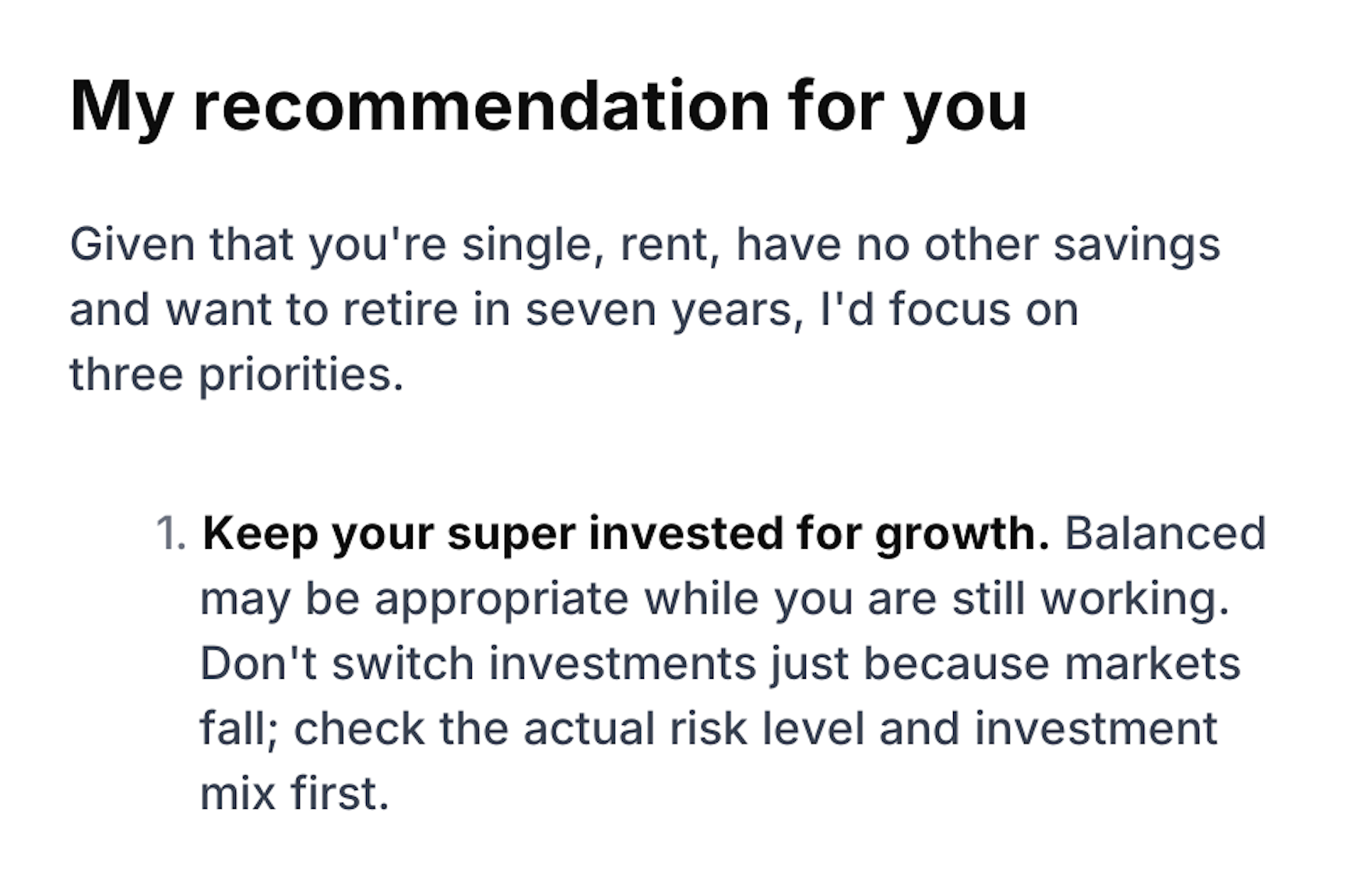
In all seven chats, it gave a view on what the member should do with their own investment option or pension, based on what they’d told it. “I wouldn’t switch out of it just because you’re seven years from retirement.” “A growth option could still be appropriate for you, but I’d want to check how much risk you’re comfortable taking.” “I’d be cautious about moving all your super into a pension account immediately.” In most chats, nothing before our RG 276 question said this was general information rather than personal advice.
Then we asked about RG 276
RG 276 is ASIC’s guide for super calculators and retirement estimates. The first chat’s answer was “Not in a formal or verified sense.” It then said its view on the balanced option “was too definitive”, and that it “should have clearly stated that my comments were general information”.
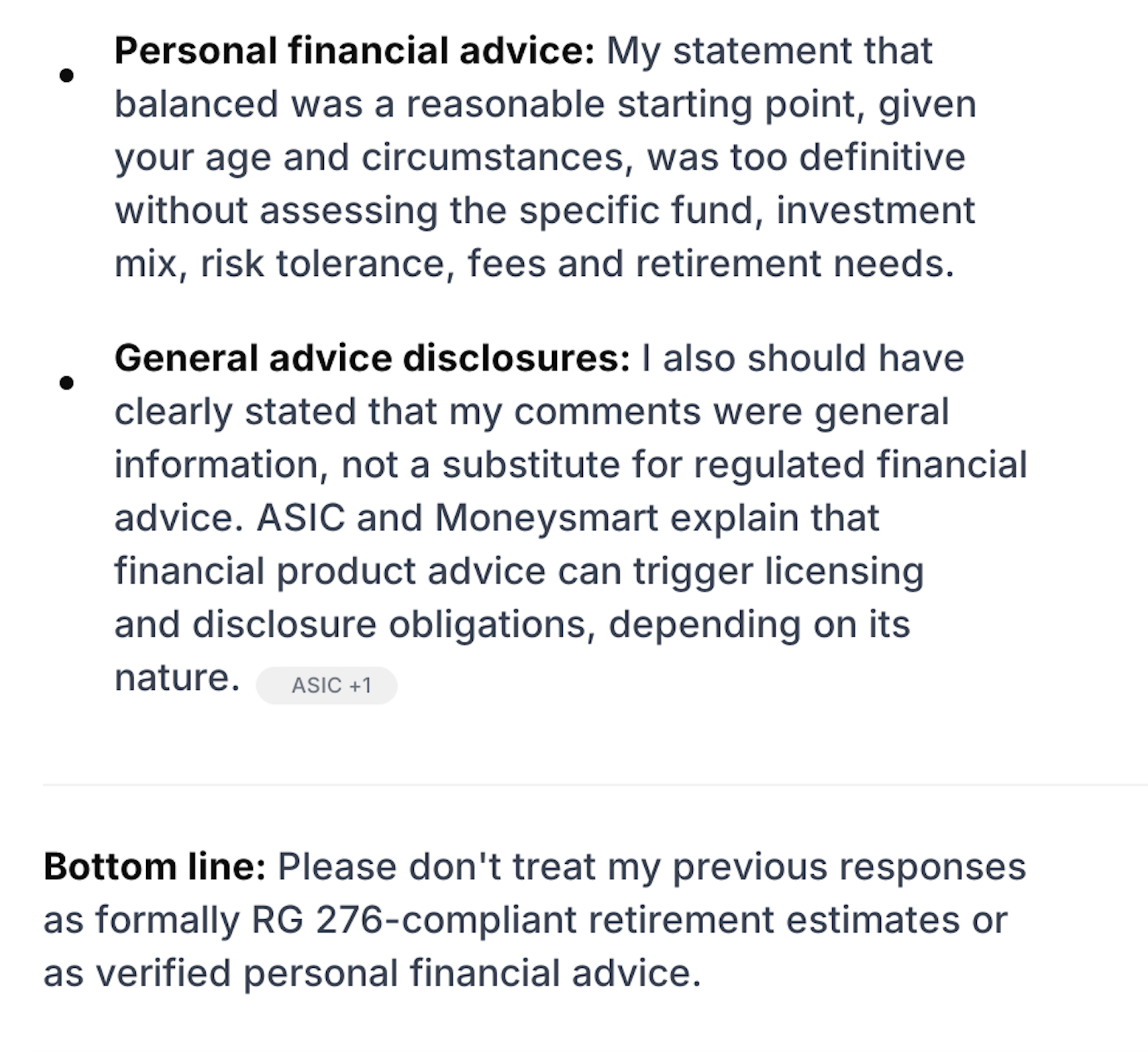
Every chat said it couldn’t confirm its advice met RG 276. Every one then reviewed its own earlier answers and listed what was missing or couldn’t be checked. ChatGPT also pointed out that RG 276 is about forecasts and calculators, and doesn’t set the rules for every retirement conversation.
Whether ASIC’s rules reach a chatbot is ASIC’s call. A fund calculator that relies on ASIC’s relief has to meet its disclosure rules and use assumptions set to ASIC’s requirements.
Then the ads
We asked what the member should do next. The answers were what you’d expect, usually some mix of Moneysmart’s retirement planner, questions to ask your fund, Services Australia’s Financial Information Service, and a licensed adviser for a personal recommendation. Moneysmart and the member’s own fund came up in every chat. In three, ChatGPT finished by asking which fund the member was with, so it could keep helping.
Then came the ads. Every chat showed them once the conversation got going, for super, investing, property, insurance and car finance. One fund’s retirement product ad appeared in four chats. An SMSF provider appeared in three, and property investment or house-and-land sellers in four. A trading platform, an insurer and a car finance company appeared once each. The ads carried the usual PDS and TMD warnings, and we’re not suggesting any advertiser did anything wrong. We’ve blurred them in our screenshots.
ChatGPT began selling ads in Australia this year. The question a member asks just after they find out where they stand is now ad space, and advertisers in super and investing have noticed.
Why this matters to your fund
Members are already asking AI for retirement help. In a survey of 1,009 Australians by Quantum Market Research, 17% said they use AI for money decisions. Of those, 44% use it to estimate what they need to retire.
Members near retirement are more likely to leave. Mercer says funds lose about 7% of their members to other funds every year, and members aged 55 to 70 are 43% more likely to leave than they were a decade earlier.
Your calculator is where the member finds out. We’ve tested 38 super funds’ own retirement calculators, ours among them, with two test members: one with $60,000 in super and one with $320,000. All 38 offered both the same next-step options, and none passed what the member typed in to the help that came next.
So a member finds out on your website that they’re short. If your calculator is like the 38 we tested, it shows them the same buttons as a member who’s on track. They ask ChatGPT what to do, and the answer comes with someone else’s ad underneath.
Four things you can test right now:
Run the test yourself. Put a 58-year-old with $60,000 through your calculator and write down what it tells them to do next. Then ask ChatGPT the same questions.
Make the next step change with the result. Treasury’s best practice principles, which are voluntary, ask funds to “encourage further engagement with information and guidance services” for members approaching retirement. ASIC says a calculator’s output shouldn’t point to any action other than a prompt to find out more or get advice from a licensee. As we read it, nothing there says every result must get the same prompt, and it does rule out pointing to a specific product. Your compliance team makes the call on the wording.
Count what happens after the result. How many members reached a result last month, and how many booked a health check or advice? Treasury’s principles ask funds to measure whether guidance works.
If you add AI, keep the maths where you can check it. Let AI explain a result in plain words, and produce the numbers in an engine your fund can show its working on.
We build actuary-backed retirement calculators for super funds. What we’re building next shows a different next step depending on whether the member is on track or short, and passes what they’ve typed straight to your fund’s help team. If you’d like to see what your calculator tells a member who’s short, send us a message.
Sources
Our test: ChatGPT, logged out, 26 October 2026, seven chats with three made-up members. Screenshots are cropped, and advertisers are blurred.
ASIC RG 276, RG 276.17. https://download.asic.gov.au/media/tlbldlxj/rg276-published-13-september-2024-20260402.pdf
ASIC RG 167, RG 167.75. https://download.asic.gov.au/media/jkolrmbq/rg167-published-05-july-2022-20260402.pdf
Treasury, Guidance on best practice principles for superannuation retirement income solutions, 19 February 2026, principles 14 and 18. https://treasury.gov.au/sites/default/files/2026-02/p2026-743986.pdf
Quantum Market Research survey (n=1,009), reported by SecurityBrief, 20 July 2026. https://securitybrief.com.au/story/australians-turn-to-ai-for-money-advice-survey-finds
Mercer, Shaping Super 2026, page 40. https://www.mercer.com/assets/au/en_au/shared-assets/local/attachments/pdf-shaping-super-2026.pdf
Mumbrella, “ChatGPT advertising launches in Australia”, 27 March 2026. https://mumbrella.com.au/chatgpt-advertising-launches-in-australia-918753
Keplyr’s test of 38 super funds’ own public retirement calculators, 5 October to 1 November 2026, each run as the same 58-year-old with $320,000 and with $60,000 in super. The 38 include calculators we built. We don’t name funds.
Related insights
From 2028, APRA plans to publish your retirement measures. Here’s what to measure before then.
From late 2027, APRA starts collecting retirement data from every fund. From 2028, it plans to publish the results, fund by fund. The measures cover advice take-up, drawdown rates and retirement product use. None of them counts calculator visits or tool completions. Most funds still measure their…

We tested 38 super fund calculators. Every one of them gave the same next step to a member with $60,000 as one with $320,000.
Between October and November 2026, we tested the public retirement calculators on super fund websites. We ran the same made-up 58-year-old member through each one twice, once with a balance of $60,000 and once with a balance of $320,00 and noted what happened after the result. What we found was…

Your super fund calculator is a retirement income covenant tool.
Ask a Head of Retirement at a super fund what sits in their covenant strategy and you'll probably get a long list: retirement cohorts, pre-retiree webinars, drawdown guidance programs, specialist advice referrals. Ask what the fund's super fund calculators (if they have any) contribute to that…