
November 17, 2026 · 7 min read
We tested 38 super fund calculators. Every one of them gave the same next step to a member with $60,000 as one with $320,000.
Between October and November 2026, we tested the public retirement calculators on super fund websites. We ran the same made-up 58-year-old member through each one twice, once with a balance of $60,000 and once with a balance of $320,00 and noted what happened after the result. What we found was consistent across industry, retail, public sector and corporate funds, large and small: every calculator offered both members the same next step.
In brief
Between 5 October and 1 November 2026 we tested the public retirement calculators on 57 super fund websites, across industry, retail, public sector and corporate funds, large and small, plus brand websites inside funds and two state schemes. 38 run a calculator of their own. The other 19 link to ASIC's Moneysmart.
We ran the same made-up 58-year-old through each one twice, once with $320,000 in super and once with $60,000. 22 of the 38 told the member in plain words whether they were on track. Then all 57 offered both runs the same next-step options.
None passed what the member had typed into the next step. Two went from the result straight to booking a phone appointment with the fund’s own team, and none straight to booking advice.
In 20 of the 38, nothing from inside the calculator reached the analytics on the rest of the fund's website.
The 29 include calculators we built, and ours give both members the same next step tool.
What we did
We tested the public retirement calculators on the websites of 43 super funds, across industry, retail, public sector and corporate funds, large and small. 29 have a calculator of their own. For the other 14, the calculator on their public website is a link to ASIC’s Moneysmart.
Every test used the same made-up member: 58, single, earning $85,000, owning a home and planning to retire at 65. We ran each calculator with $320,000 in super, then again with $60,000, and wrote down what it offered next. We also checked what the calculator sent to the analytics on the fund’s own website. Public pages only, on a desktop and a phone, between 5 October and 1 November 2026.
We tested what someone who isn’t logged in sees. A fund may do more for a member once they log in, or follow up later by email. We don’t name funds, and we don’t judge their products, fees or returns. This is about what the website does after the answer.
Every member gets the same next step
Many calculators get the first part right. 22 of the 38 told the member in plain words whether they were on track, close or short.
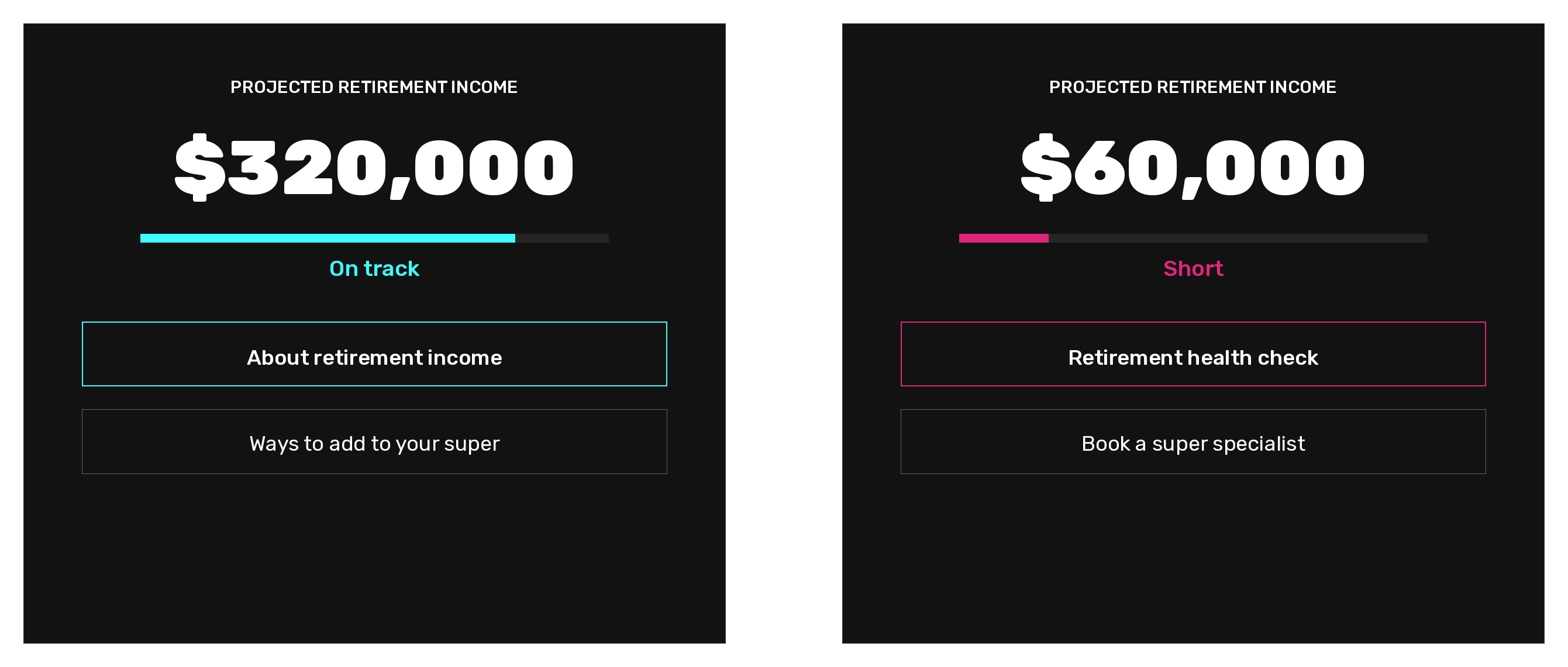
Then all 29 offered the member with $60,000 the same next-step options as the member with $320,000. In all but one, the buttons under the result were word for word the same apart from the numbers. In the other, both members saw the same four panels, including one for members on track and one for members who aren’t, and had to pick one themselves.
ASIC’s guidance says a calculator’s output shouldn’t point to any action other than a prompt to find out more or to get advice from a licensee. It also says the output “may include a link to a ‘find an adviser’ tool”. A super calculator mustn’t advertise or promote a specific product, and ASIC’s example is one of the trustee’s own super or retirement income products. As we read it, nothing there says every result must get the same prompt. A member who’s short could be pointed to a retirement health check. A member who’s on track could get general information about retirement income, rather than a page for one of the fund’s own products. Your compliance team makes the call on the words.
The answer stays behind
To get a result, the member tells the calculator their age, income, super balance and when they want to retire. Those are the first things an adviser asks.
None of the 38 passed any of it into the next step. A member who clicks through to the fund's help has to tell the fund everything again.
None of the 38 goes straight from the result to booking advice
Four of the 38 went from the result straight to booking time with the fund's own people: an advice appointment, a phone appointment with a guidance team, a coach call and a call with a super specialist. 16 linked to a general advice page with a booking option further down. The other 18 offered no booking from the result.
In 20 of the 38, the fund’s own analytics see nothing from the calculator
In 20 of the 38, nothing from inside the calculator reached the analytics on the rest of the fund's website. In 19 of those, the calculator's data went to the provider's own analytics, which the fund may or may not be able to see. In the other, we couldn’t see it sending anything at all. Either way, the fund’s own team can’t count how many members reached a result, or what they did next, unless the provider shares it.
19 funds send members to ASIC’s Moneysmart
For 19 of the 57 websites, the retirement calculator is a link to ASIC's Moneysmart. Moneysmart is the regulator's own service. In our test, none of the 19 got a link from the result back to the fund's own help, and nothing from Moneysmart reached the fund's analytics.
Why this matters to your fund
Members near retirement leave more often than they used to. Mercer says funds lose about 7% of their members to other funds every year, and members aged 55 to 70 are 43% more likely to leave than they were a decade earlier.
Treasury’s principles describe the job. They’re voluntary. They ask funds to design guidance services that help members choose, “for example through personas or assisted choice tools”, and to encourage members approaching retirement to use information and guidance. A retirement calculator is already halfway there.
Four things you can test right now:
Run our test on your own calculator. Put in a 58-year-old earning $85,000 with $320,000 in super, then again with $60,000. Write down what each is offered next.
Write a next step for each kind of result. Short, close and on track. For example, a retirement health check for the member who’s short, ways to add to super for one who’s close, and general information on retirement income for one who’s on track. Have compliance approve the words.
Put your help one click from the result. When a member asks your fund for help, your team should start from what they’ve already typed, with the member’s OK.
Count it in your own analytics. How many members reached a result last month, how many clicked the next step, and how many booked? If the calculator’s data goes to your provider’s analytics, ask for it in yours.
We build actuary-backed retirement calculators for super funds, and ours are in the 38. What we’re building next shows a different next step depending on whether the member is on track or short, and passes what they’ve typed straight to your fund’s help team. If you’d like to see what your calculator offers the member with $60,000, send us a message.
Sources
Our test: Keplyr’s Retirement Action Scorecard, 5 October to 1 November 2026. The public retirement calculators of 43 super funds, 29 of them the fund’s own and 14 links to ASIC’s Moneysmart, each run twice as the same made-up member, public pages only. The 29 include calculators we built. We don’t name funds.
ASIC RG 167, RG 167.75. https://download.asic.gov.au/media/jkolrmbq/rg167-published-05-july-2022-20260402.pdf
ASIC RG 276, RG 276.86 to RG 276.88. https://download.asic.gov.au/media/tlbldlxj/rg276-published-13-september-2024-20260402.pdf
Treasury, Guidance on best practice principles for superannuation retirement income solutions, 19 February 2026, principles 11 and 14. https://treasury.gov.au/sites/default/files/2026-02/p2026-743986.pdf
Mercer, Shaping Super 2026, page 40. https://www.mercer.com/assets/au/en_au/shared-assets/local/attachments/pdf-shaping-super-2026.pdf
Related insights
From 2028, APRA plans to publish your retirement measures. Here’s what to measure before then.
From late 2027, APRA starts collecting retirement data from every fund. From 2028, it plans to publish the results, fund by fund. The measures cover advice take-up, drawdown rates and retirement product use. None of them counts calculator visits or tool completions. Most funds still measure their…
We asked ChatGPT what a 58-year-old should do with their super. A super fund’s ad was waiting under the answer.
On 26 October 2026, we asked ChatGPT to help three made-up members plan their retirement. It gave each one a view on their investment option, asked for more details, and in most chats didn’t mention this was general information until we brought up RG 276. Then the ads appeared: super, investing,…

Your super fund calculator is a retirement income covenant tool.
Ask a Head of Retirement at a super fund what sits in their covenant strategy and you'll probably get a long list: retirement cohorts, pre-retiree webinars, drawdown guidance programs, specialist advice referrals. Ask what the fund's super fund calculators (if they have any) contribute to that…